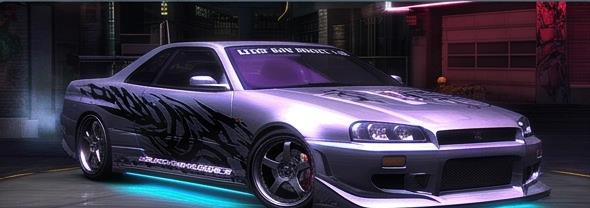
NEED FOR SPEED: UNDERGROUND 2 — THE DEFINITIVE GUIDE TO BAYVIEW, PLATFORM GRAPHICS, AND HIDDEN PROGRESSION
When I loaded into Bayview for the first time in November 2004, the import tuner craze was at its absolute peak. The streets smelled of unburnt fuel and vaporized rubber, neon underglow lit up the damp asphalt, and Snoop Dogg's drawl over The Doors' "Riders on the Storm" was looping through my speakers. Need for Speed: Underground 2 did not just capture that era; it helped define the entire Y2K tuner subculture along with The Fast and the Furious.
I put hundreds of hours into every release of this game, tearing down performance builds on the dyno, hunting hidden garages, and pushing cars through technical mountain runs. If you are revisiting this classic on original hardware, picking up a copy for a retro CRT setup, or setting up an emulator, I put together this definitive guide covering version comparisons, hidden progression fixes, and vehicle tuning.
Technical Shootout: NFS Underground 2 PC vs PS2 Graphics
Back in 2004, we did not have identical cross-platform builds. The version of NFSU2 you owned dictated your visual and audio experience.
The PC release was the undisputed visual king. When running on capable hardware, the PC build supported resolutions far beyond standard television standards (1024×768, 1280×1024, and 1600×1200) alongside unlocked frame rates that breezed past 60 frames per second. More importantly, the PC version had an exclusive visual setting called "Enhanced Contrast". This was an early implementation of dynamic tone mapping: it calculated scene brightness in real time, blowing out street lamps and neon signs over rain-soaked pavement while keeping the asphalt deep and inky. Paired with driver-level anisotropic filtering, the PC edition delivered a sharp, cohesive presentation that consoles could not replicate.
If you were strictly playing on home consoles, the original Microsoft Xbox took first place. With its 733 MHz processor and Nvidia NV2A chip, the Xbox ran at a crisp, locked 30 frames per second with native 480p progressive scan and full 16:9 anamorphic widescreen support. The Xbox hardware filtered textures cleanly, eliminating distant jagged lines. It also had the best audio of any version: a discrete, hardware-encoded Dolby Digital 5.1 surround sound mix that accurately panned turbo flutter and passing traffic around the room.
The PlayStation 2 version holds a unique spot because it served as EA Black Box's lead development platform. Because artists tailored the game around the PS2's Graphics Synthesizer, its wet-road reflections, motion-blur trails during nitrous bursts, and streetlamp halos looked natural and moody. However, the hardware held it back: the PS2 lacked 480p progressive scan support, locking you to an interlaced 480i image. Without dedicated texture filtering, road textures shimmered, straight edges crawled with jagged pixels, and the frame rate occasionally hitched when multiple cars collided in busy intersections. The PS2 also suffered from sluggish load times, taking roughly ten seconds longer than the Xbox or GameCube to load races.
The Nintendo GameCube version was easily the weakest of the home releases. Although it supported 480p progressive scan and loaded quickly, the visual translation suffered. The lighting values were improperly balanced, washing out dark city alleys with a flat, overly bright haze that ruined the late-night street atmosphere. EA also compressed the environmental textures and scaled back weather effects like rain droplets and spray. To make matters worse, the GameCube had zero online multiplayer support and forced players to swap discs mid-campaign because the game exceeded the capacity of a single Nintendo mini-DVD.
| Platform | Best Video Output | Target Frame Rate | Texture Filtering | Audio Format | Standout Visual Features |
|---|---|---|---|---|---|
| PC (Windows) | Uncapped (1600×1200+) | 60+ FPS | Anisotropic | 2-Channel Stereo | Enhanced Contrast, high-res textures, full particle density. |
| Microsoft Xbox | 480p Progressive Scan | 30 FPS (Locked) | Hardware Trilinear | Discrete Dolby Digital 5.1 | Crisp 16:9 widescreen, smooth edge filtering, punchy audio. |
| Sony PlayStation 2 | 480i Interlaced Only | 30 FPS (Drops in traffic) | Point / Bilinear | Dolby Pro Logic II | Tailored lighting halos, rich wet-surface shaders, long load times. |
| Nintendo GameCube | 480p Progressive Scan | 30 FPS | Bilinear (Compressed) | Dolby Pro Logic II | Washed-out lighting, missing online mode, two-disc split. |
Regional Garage Rosters: NFS Underground 2 PAL vs NTSC Car List
When comparing retail discs across regions, you will find that the car rosters were split based on local tuner markets. Both regional discs contained 29 drivable vehicles in career mode, but the total pool of unique vehicles across both builds was 31.
- NTSC (North America / Japan): Features the 2000 Honda Civic Si coupe and the 2004 Acura RSX Type-S.
- PAL (Europe / UK / Australia): Replaces the Civic and RSX with two popular European hot hatches: the Peugeot 106 GTI and the Vauxhall / Opel Corsa 1.8.
This swap dramatically changed early-game progression. In the PAL edition, the lightweight Peugeot 106 became an immediate powerhouse on tight, twisty circuits, while NTSC players had to rely on the Civic Si or rear-wheel-drive platforms to tackle early stages.
Starter Car Shootout: Toyota Corolla GT-S (AE86) vs Nissan 240SX (S13)
When Rachel Teller hands you the keys at the car lot in Stage 1, you can pick from six starting platforms. Two of them stand head and shoulders above the rest: the Toyota Corolla GT-S (AE86) and the Nissan 240SX (S13).
The Corolla AE86 is arguably the strongest chassis in the entire game due to a quirk in EA Black Box's physics engine. Because of its ultra-light curb weight and rear-wheel-drive layout, the AE86 generates supernatural cornering grip and rotates instantly through low-speed transitions. Once you install Stage 2 and Stage 3 weight reduction, suspension, and turbo kits, its power-to-weight ratio allows it to outperform modern all-wheel-drive supercars on technical circuits and Street X events.
The Nissan 240SX is the more balanced all-rounder. With a longer wheelbase than the Corolla, the S13 offers forgiving, predictable weight transfer that makes it the premier drift car for beginners and veterans alike. It also handles higher torque outputs more stably in drag events.
Tuner Verdict: If you want a car that hugs corners like a slot car, pick the Corolla. If you want a forgiving platform that can drift smoothly and launch hard down drag strips, grab the 240SX.
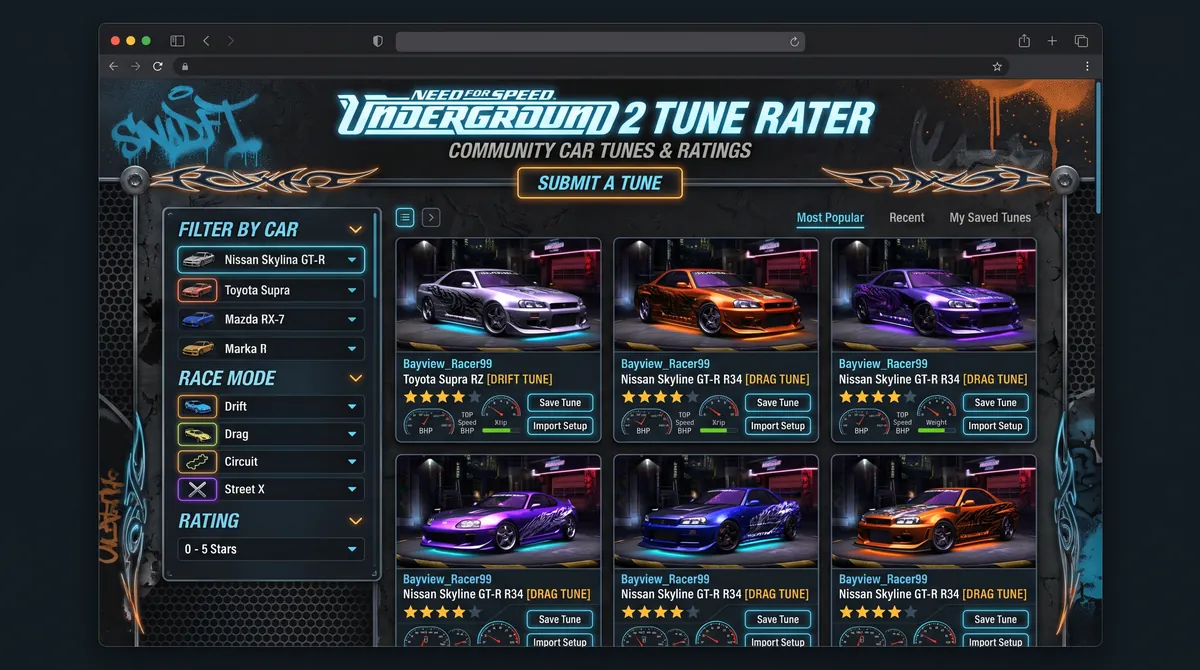
Navigation Tricks: NFSU2 Hidden Shops & Exterior Map Light Colors
When you explore Bayview, the in-game GPS will not mark performance shops, body garages, paint booths, specialties shops, or car lots until you drive directly past their entrances. Rather than wandering blind, you can use the game's environmental visual language to find them quickly.
Look for streetlamps casting saturated, colored pools of light onto the wet road surface. Whenever you see a colored glow on the street, an alleyway nearby leads directly to an unmarked shop entrance. Roadside directional signs also display colored geometric markers pointing toward these commercial zones.
Engine blocks, transmissions, ECUs, turbos, brakes, suspension kits, tires, nitrous systems, weight reduction, and the full interactive Stage 3 dyno bay.
Front and rear bumpers, side skirts, spoilers, custom carbon hoods, roof scoops, headlights, taillights, side mirrors, exhaust tips, and widebody conversions.
Underglow neon, engine neon, trunk neon, headlight tints, window film, hydraulics, scissor doors, custom gauge faces, and trunk-mounted audio subwoofers/amplifiers.
Base coat paint (gloss, metallic, pearl), rim paint, brake caliper paint, vinyl graphics (tribal, stripes, body graphics), and manufacturer sponsor decals.
Purchasing brand new stock vehicle chassis, test-driving platforms, trading in cars, and managing your 5-car garage roster.
Campaign Progress Fixes: NFS Underground 2 Stuck at 98 Percent
Almost every player who ran through Bayview back in the day hit a wall where races vanished from the map, leaving career progression frozen somewhere between 65% and 98%. If your career is stuck, check these three progression mechanics:
1. The Visual Rating Lock
Your active car's visual star rating is a mandatory campaign gate. The game requires your car to hit visual thresholds, maxing out at a full 10.0-star rating in Stage 5. Reaching these thresholds unlocks exclusive DVD cover photo shoots. If you do not trigger and complete these photo events, the game will refuse to spawn the final Underground Racing League (URL) tournaments needed to complete the stage. If your map is empty, drive to a Car Specialties shop and install trunk-mounted audio amplifiers, neon kits, scissor doors, and custom hood hinges until your star meter hits maximum.
2. Unmapped Hidden Races and the Garage Map Glitch
Every stage scatters three to five hidden races across the streets that never appear on your minimap or GPS. You can view and launch these missed races from the World Map inside your Garage menu.
Keep in mind that races launched directly from the garage menu pay out zero bank credits upon victory. To bypass this restriction, launch an uncompleted race from the garage map, pause the game as soon as the starting countdown begins, and choose "Restart Race". The engine will reset the event and register you as entering from free-roam, paying out full cash prizes when you cross the finish line.
3. The Stage 3 Missable Street X Events
There are two hidden Street X races in Stage 3 that do not appear in the garage World Map. If you finish all URL events and move to Stage 4 without finding and beating these two races on the street, you are locked out permanently, making a true 100% save file impossible on that profile.
Unlocking Missable Outrun Rewards and Widebody Kits
Outrun races involve chasing down roaming rival tuners in free-roam, flashing your high beams, and pulling a 1,000-foot gap on them through traffic.
Winning Outruns unlocks Unique parts that cannot be purchased anywhere else. These unlocks are stage-locked: if you advance to the next narrative stage without logging the required number of Outrun wins, those unique parts are lost forever on that save file.
The widebody kit unlock is the most missed upgrade in the game. You can unlock one of four widebody kits (Mantis, Vapor, Apocalypse, or Armageddon) for your career car by winning 11 Outrun races in Stage 5.
| Career Stage | Required Outrun Wins | Unique Reward Category | Upgrade Choices |
|---|---|---|---|
| Stage 2 | 4 Wins | Unique Hood | Custom Carbon Fiber Hoods |
| Stage 3 | 3 Wins | Unique Performance (Group 1) | Engine, Transmission, or Tires |
| Stage 3 | 6 Wins | Unique Wheels | Exclusive Wheel Designs |
| Stage 4 | 4 Wins | Unique Spoiler | High-Downforce Rear Spoilers |
| Stage 4 | 6 Wins | Unique Vinyl | Multi-Layer Vinyl Designs |
| Stage 4 | 9 Wins | Unique Performance (Group 2) | ECU, Turbo, or Brakes |
| Stage 5 | 6 Wins | Unique Performance (Group 3) | Nitrous, Weight Reduction, or Suspension |
| Stage 5 | 11 Wins (Before Caleb) | Unique Widebody Kit | Choice: Mantis, Vapor, Apocalypse, or Armageddon |
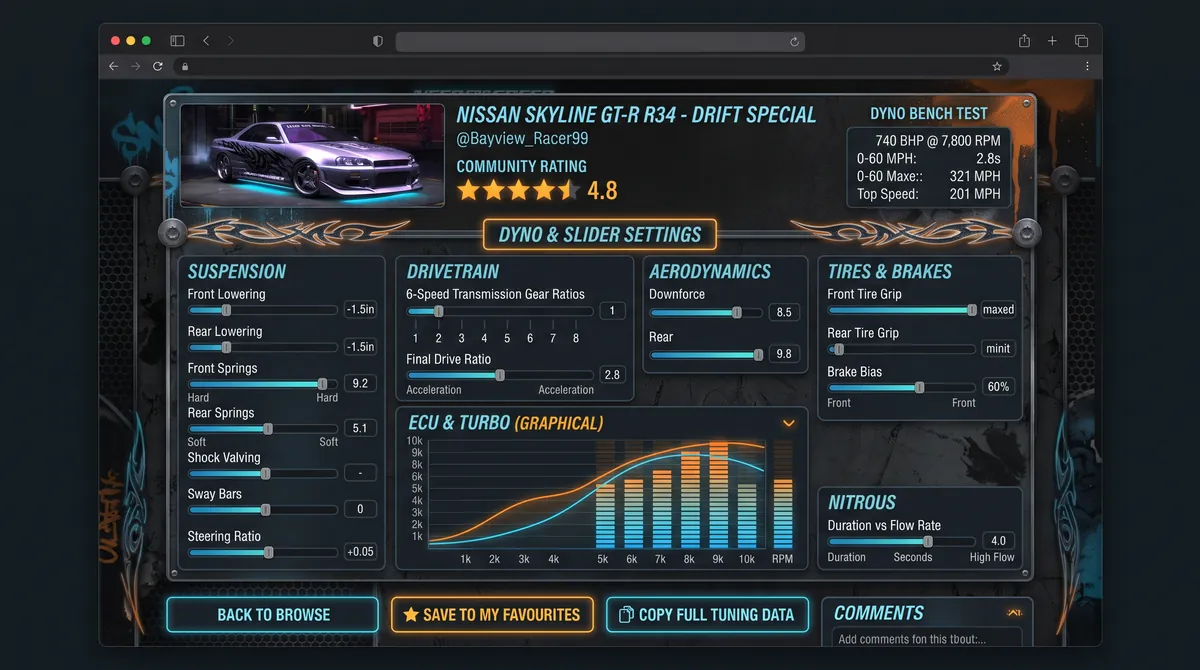
Dyno Room Guide: NFSU2 Dyno Tuning Settings
Slapping Level 3 parts on your car only gets you halfway there. Taking your build to the Performance Shop's dyno bay lets you tune your setup for specific race types:
- Suspension & Steering: For Street X and technical circuits, lower ride height to minimum, stiffen front springs, and slightly soften the rear to eliminate body roll. For Drift, soften the rear suspension and increase front tire pressure to promote controllable oversteer.
- Aerodynamic Downforce: Maximize downforce on both spoilers for Street X and tight URL tracks. For high-speed highway sprints, slide downforce low to reduce drag and reach top terminal velocity.
- Gear Ratios: Shorten your final drive gear ratio for Street X kart tracks to stay in the powerband. For drag racing, stretch 4th and 5th gears to prevent hitting redline before the finish trap.
- Nitrous Delivery: Use short, high-flow duration for explosive drag launches, and long, low-flow delivery (8-10 seconds per shot) for endurance URL racing.
Want exact slider values instead of rules of thumb? Browse community-rated NFSU2 dyno tunes, with full suspension, gearing, aero, nitrous and ECU settings for each car and race type.
Handheld Spin-offs: GBA, DS, and Underground Rivals
The handheld versions of NFSU2 were completely separate games built around portable hardware limitations:
- Game Boy Advance (GBA): Developed by Pocketeers with a custom software 3D engine, scrapping the open world for a 16-car menu arcade racer with surprisingly detailed 3D vehicle models.
- Nintendo DS: Also developed by Pocketeers, featuring full 3D polygonal tracks and a unique stylus touchscreen vinyl editor for hand-drawn graphics.
- PlayStation Portable (Underground Rivals): EA Canada's independent 2005 spin-off ditching Bayview for linear tournament ladders and introducing American muscle like the C5 Corvette Z06 and Ford Mustang SVT Cobra.
The Legacy of Bayview
Need for Speed: Underground 2 remains an exceptional snapshot of mid-2000s street racing culture. While subsequent entries like Most Wanted shifted the focus toward daylight police pursuits, NFSU2 stands as the definitive tribute to import tuners, custom bodywork, and midnight cruising.
Whether you play the PC release with Enhanced Contrast enabled, pop an Xbox disc into a 480p CRT setup, or pull an all-nighter behind the wheel of a Corolla AE86, Bayview's neon streets still deliver the ultimate tuner fantasy.
You can even race other players again: our hands-on NFSU2 Revived review covers playing Underground 2 in a browser tab with online multiplayer, built-in mods and save management.